Dry ashing is the standard way to measure the mineral residue of food: the sample is charred, incinerated in a muffle furnace, and the inorganic remainder is weighed to constant weight. For cereals, pulses and their milled products, ISO 2171:2023 specifies two incineration regimes — 550 ± 10 °C for salt-containing products in quartz or silica dishes and 900 ± 25 °C for flour in platinum-rhodium dishes — while ISO 5984:2022 covers crude ash of animal feeding stuffs. National food standards organize the same work into three separate determinations: total ash, the water-soluble and water-insoluble fractions of that ash, and the acid-insoluble fraction that exposes sand, talc and other acid-resistant adulterants in spices and salt. The typical constant-weight criterion is a mass difference of no more than 0.5 mg between successive weighings, and high-phosphorus foods require magnesium acetate as an ashing aid with a matching blank correction.
1. One method standard, three ash fractions
Ash determination looks like a single number but splits into three related measurements. Total ash is everything left after complete incineration — the oxide and salt residue of the minerals the food carried, plus any inorganic contamination. Dissolving that ash in near-boiling water and re-igniting the residue gives the water-insoluble fraction, and the difference between total and insoluble ash is the water-soluble fraction, a quality marker used in tea and salt grading. Treating the ash with dilute hydrochloric acid, boiling briefly and re-igniting yields the acid-insoluble fraction, which is dominated by silica: a spike here is the classic fingerprint of sand, grit or talc adulteration in spices, salt and cereals. Recent national method standards consolidated what used to be twenty separate documents into one, defining all three determinations and their temperature regimes in a single text — which makes the three fractions easier to report consistently across a laboratory.
2. Method 1: total ash, step by step
Work starts with the crucible, not the sample. A clean porcelain or quartz dish is fired at 550 ± 25 °C for about 30 minutes, cooled to roughly 200 °C in the furnace, then held in a desiccator for 30 minutes and weighed; firing and weighing repeat until two successive readings agree within 0.5 mg. Test portions are 2 to 3 g for ash-rich products or 3 to 10 g for leaner ones, weighed to 0.0001 g and spread loosely, never compacted. Liquid samples are first evaporated to dryness on a water bath before charring. Consistent desiccator time matters more than it appears, because ash is hygroscopic and every extra minute on the balance adds mass the furnace never produced. Recording the constant crucible weight before the sample is loaded removes one of the two largest systematic errors in the whole determination.
The sample is charred gently on a hot plate until no further smoke appears — an open flame is prohibited because it drives particles out of the dish and biases the result low. The dish then goes into the muffle furnace at 550 ± 25 °C for four hours. High-phosphorus materials such as pulses, meat and poultry products, eggs, fish products and dairy need help: a measured dose of magnesium acetate solution, either 1.00 mL of a 240 g/L solution or 3.00 mL of an 80 g/L one, is added to the test portion, held for ten minutes and evaporated to dryness before charring, with an identical blank carried through the whole procedure so the added magnesium can be subtracted exactly. Starch-based products take a separate route: their crucibles are pre-cleaned with boiling dilute hydrochloric acid and fired at 900 ± 25 °C.
| Food category | Incineration temperature | Special treatment |
|---|---|---|
| General foods | 550 °C ± 25 °C | Low-flame charring until no smoke remains |
| Starches and modified starches | 900 °C ± 25 °C | Crucibles pre-washed with boiling dilute HCl; applicable where ash ≤2% |
| High-phosphorus foods (pulses, meat, egg, fish, dairy) | 550 °C ± 25 °C | Magnesium acetate ashing aid + blank test |
3. Constant weight at 0.5 mg and the calculation
After the four-hour burn the dish is cooled and weighed, fired again for about an hour, and the cycle repeats until two successive weighings agree within 0.5 mg — looser than the 0.3 mg criterion that pharmacopoeial residue-on-ignition tests use, but built on the same 0.1 mg readability balance. Total ash is then calculated as the mass difference between the fired dish with residue and the constant dish weight, divided by the test portion mass, and expressed either on an as-received or on a dry-matter basis. Reporting rules are explicit: three significant figures when the ash content is 10 g per 100 g or more, two below that. What the number hides is the noise floor — magnesium acetate blanks, desiccator drift and incomplete charring each consume part of a tolerance that is only half a milligram wide.
4. International counterparts and the equipment link
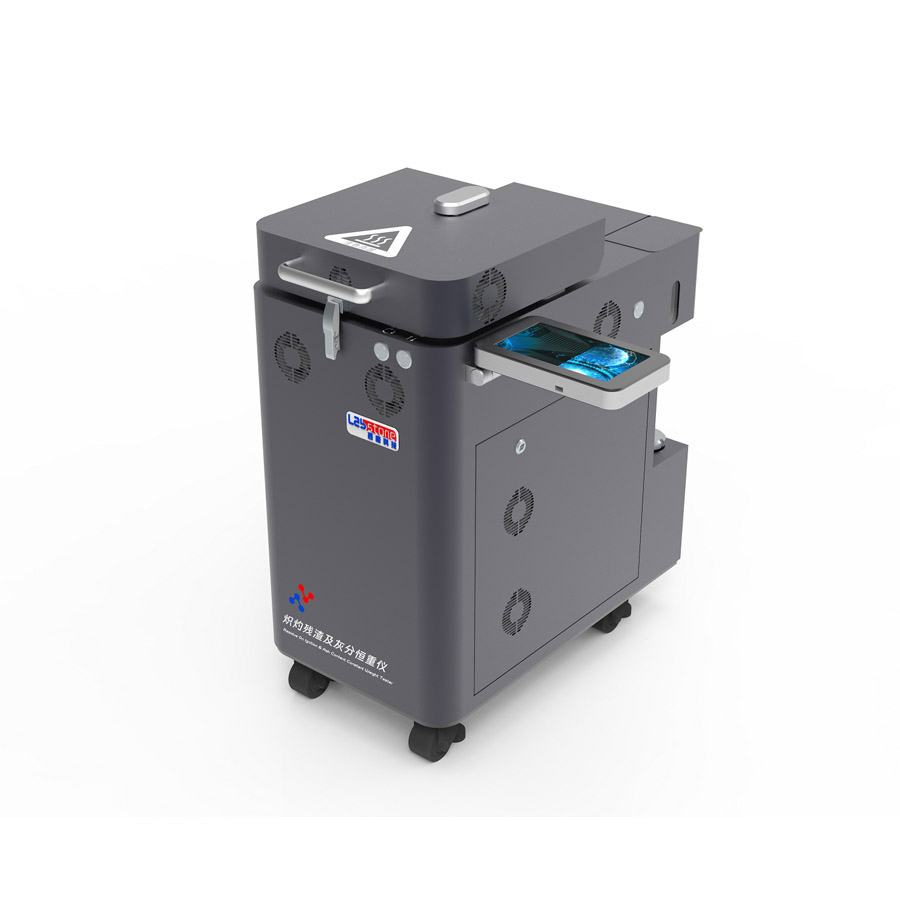
Internationally, ISO 2171:2023 is the reference for cereals, pulses and their milled products: it keeps two incineration regimes, 550 ± 10 °C with quartz or silica dishes for salt-containing products and 900 ± 25 °C with platinum-rhodium dishes for flour, with a minimum four-hour burn in the lower regime. Animal feed uses ISO 5984:2022 for crude ash, which the current national feed standard adopted with modifications when it replaced its 2007 edition on 1 February 2026. The practical consequence for laboratories is a single piece of equipment spanning both regimes: an ashing furnace with genuine long-term stability across 550 to 900 °C, plus an automated constant-weight endpoint. Judging the endpoint from a real mass-versus-time curve, rather than by operator habit, is what keeps successive 0.5 mg judgements reproducible across shifts. Both regimes sit comfortably inside the working range of a modern constant-weight ashing instrument.
- Three determinations: total ash, water-soluble / water-insoluble ash, acid-insoluble ash
- Temperatures: general foods 550 °C ± 25 °C; starches 900 °C ± 25 °C after boiling dilute HCl pre-cleaning
- High-phosphorus foods: 1.00 mL of 240 g/L or 3.00 mL of 80 g/L magnesium acetate solution, plus a blank
- Char gently until no smoke remains — no open flame; burn 4 h at 550 °C, cool 30 min in a desiccator
- Constant weight: successive weighings within 0.5 mg; total ash = (m2 − m0) / m1 × 100%
- Counterparts: ISO 2171:2023 (cereals and pulses), ISO 5984:2022 (animal feeding stuffs)